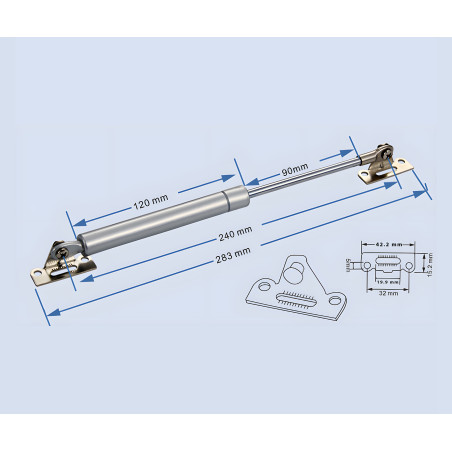
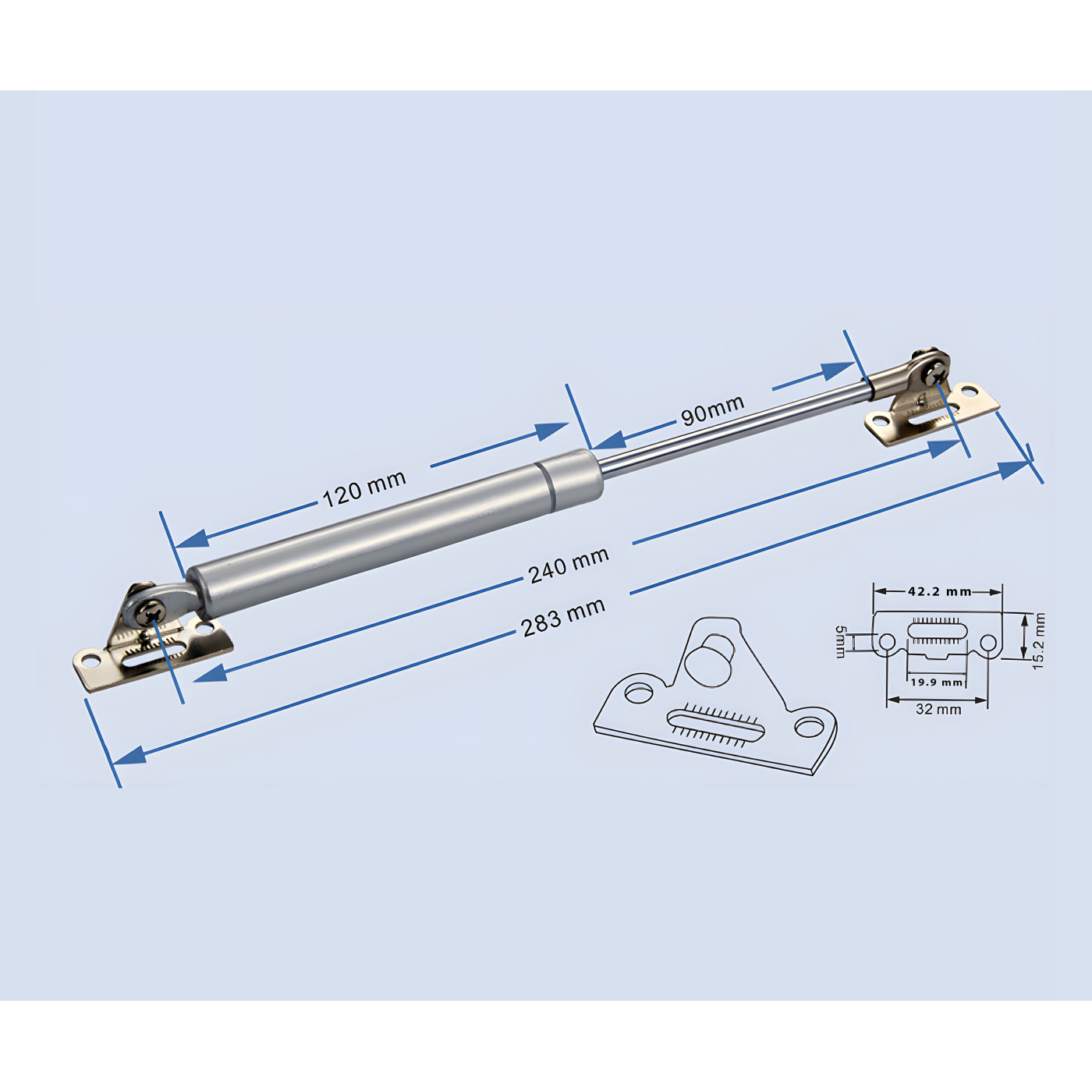
This is a universal damping gas spring (also called a gas damper), supplied with the appropriate brackets.
The difference between a gas pressure spring, a gas tension spring, and a gas damper
Gas springs and gas dampers can look similar in appearance and construction, but they behave very differently depending on their internal gas pressure and valve design.
1. Gas Compression Spring
A gas compression spring works by storing gas under pressure inside a cylinder. When at rest (with no external force applied), the gas compression spring naturally pushes outward, meaning the piston rod is pushed out of the cylinder. This makes it ideal for applications where you need to lift or support something, such as car tailgates, kitchen cabinets, or office chairs.
Mechanism: The internal gas pressure pushes the piston rod outward.
Use: To support or lift.
Examples: Car tailgates, kitchen cabinets, office chairs.
2. Gas Tension Spring
A gas tension spring works in the opposite way. When at rest, the piston rod is inside the cylinder and wants to stay there. When you pull the rod out, it creates a counteracting force that wants to pull the rod back inside. This makes gas tension springs suitable for applications where you need a constant pulling force to hold something in place or to adjust a position.
Mechanism: The internal gas pressure pulls the piston rod inward.
Use: To hold or position.
Examples: Self-closing doors or hatches, fitness equipment, and mechanical adjustment systems.
3. Gas Damper (Neutral / Mid-Position Spring)
A gas damper, sometimes called a neutral or mid-position gas spring, is designed to keep the piston rod in a neutral position rather than fully pushing out or pulling in. When you move the rod, it resists movement in both directions and tends to remain where you leave it. Unlike compression or tension springs, a gas damper does not actively lift or pull, but instead controls motion smoothly.
Mechanism: The internal gas and damping system resists movement in both directions and stabilizes the rod around its position.
Use: To control movement and keep a position stable.
Examples: Adjustable lids, soft-close or controlled-opening mechanisms, movable panels, ergonomic or positioning systems.
Specifications
Force: 60 N (6 kg)
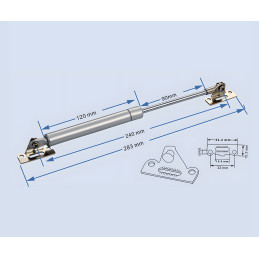
Dimensions: see photo
Color: silver
Not the right model for your application?
We sell gas dampers in 60N, 100N and 150N.
Not exactly the product you are looking for? Also take a look at the other variants in the category Gas dampers.